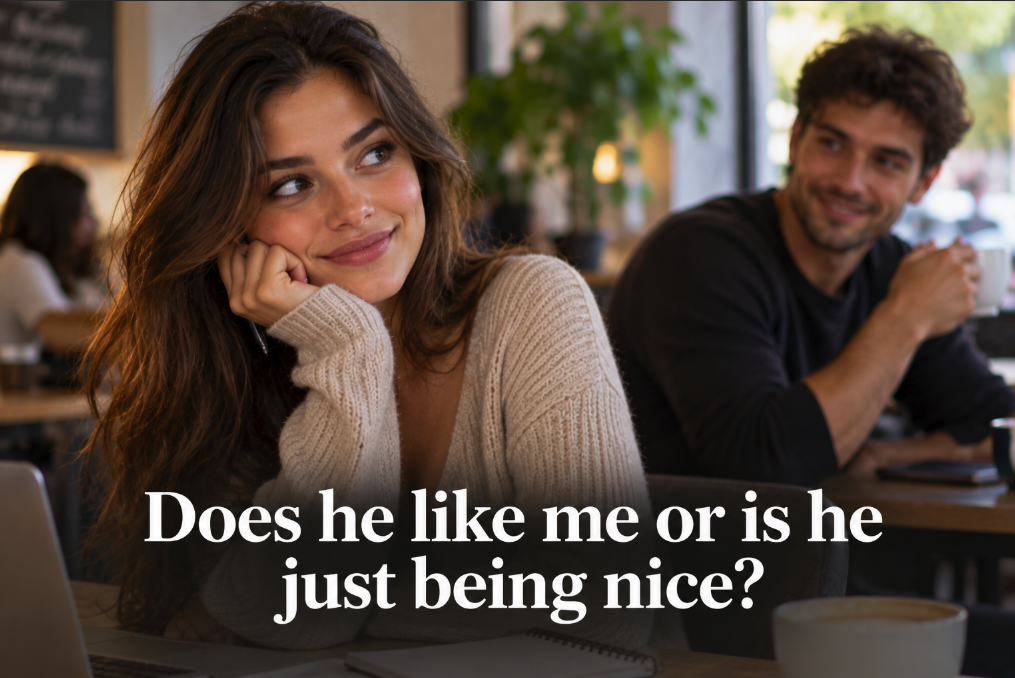
“Does he like me or is he just being nice?” may be one of the most persistent questions in dating. A quick reply suddenly feels significant. A like on an old photo looks suspiciously intentional. Eye contact lasts half a second longer than expected, and an ordinary conversation becomes evidence to analyze on the way home.
The frustrating answer is that no single message, like, smile or glance can reliably prove romantic interest. Friendly people can be attentive. Shy people can be interested while appearing distant. And when you already have a crush, ambiguous signals become remarkably easy to interpret in the direction you hope.
Look for patterns, not isolated moments
One enthusiastic text is not much evidence. Repeatedly starting conversations, remembering details you mentioned, finding reasons to spend time together and maintaining contact over time can be more meaningful because they form a pattern.
The same applies offline. Eye contact can signal attraction, but it can also signal ordinary engagement in a conversation. If it appears alongside consistent attention, proximity, playful teasing and an effort to continue interacting, the overall picture becomes more informative.
Initiative is often more useful than likes
Social media interactions are particularly easy to overread because they require so little effort. Someone liking a story or reacting to a post may be flirting, but it may also be habitual scrolling. Initiative generally tells you more.
Does he message when there is no practical reason to? Does he suggest seeing you again? Does he keep the conversation going instead of simply responding politely? Does he create opportunities for one-on-one time? None of these guarantees attraction, but consistent voluntary effort is harder to dismiss as basic friendliness.
Pay attention to whether he treats you differently
One useful question is not simply “Is he nice to me?” but “Is he this nice to everyone?” A naturally warm and outgoing person may compliment friends, send frequent messages and make sustained eye contact without romantic intent.
If the behavior toward you is noticeably more focused, playful or personal than his behavior with other people, that difference can provide useful context. Still, avoid turning every interaction into a comparison exercise. Personality and circumstances vary too much for body-language detective work to become a reliable test.
Texting chemistry can still be ambiguous
Fast replies feel exciting, but response speed alone says little. Someone can answer instantly because they are interested, because they happen to be on their phone or simply because that is how they communicate. More revealing clues may be whether they ask questions back, introduce new topics, remember previous conversations and make an effort to move the connection beyond endless messaging.
Flirting often involves reciprocity. You send a playful message and he raises the energy rather than neutralizing it. You suggest something slightly personal and he responds in kind. The interaction gradually becomes something both people are creating.
The clearest signal is usually a real step forward
There comes a point where decoding signals becomes less useful than creating an opportunity for clarity. You do not need a dramatic declaration. A simple invitation to get coffee, grab a drink or do something together can provide more information than another week of analyzing emojis.
If he is enthusiastic and helps make the plan happen, you have learned something useful. If responses remain vague and plans never materialize, that is useful information too.
So, does he like you or is he just being nice? Look for consistency, reciprocity and initiative rather than one perfect “sign.” Attraction is rarely proven by a single glance or notification. It becomes clearer when someone repeatedly chooses to move closer rather than leaving you to do all the interpreting.