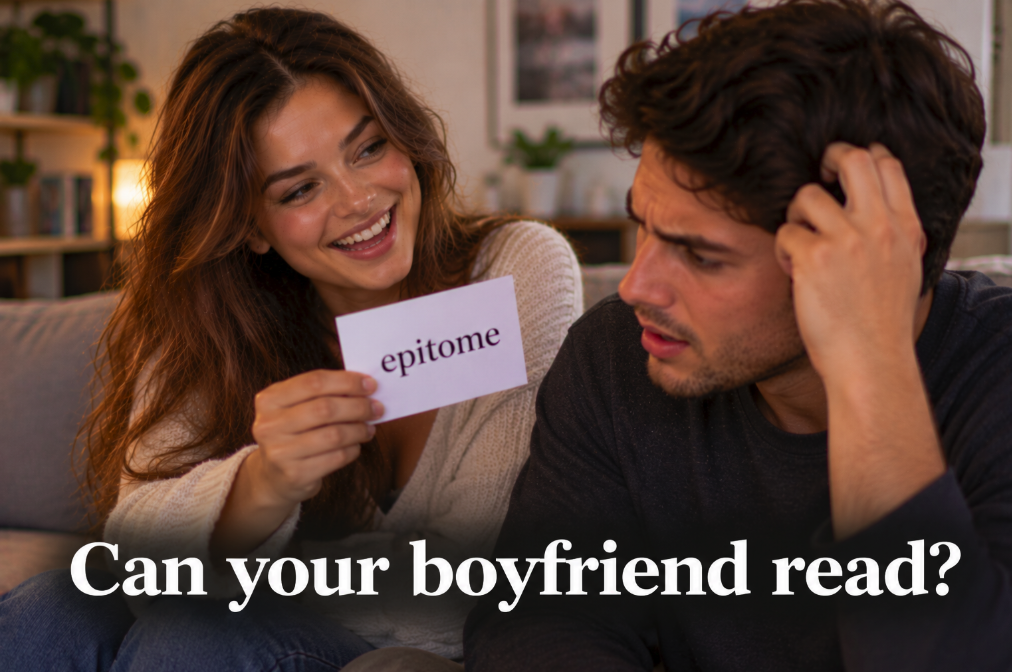
TikTok has a new relationship test, and this one starts with an aggressively simple question: “Can your boyfriend read?”
In the viral challenge spreading across the platform, women give their boyfriends or husbands lists of words and ask them to read them aloud on camera. The catch is that the vocabulary includes familiar-looking English words with pronunciations that are easy to get wrong from spelling alone. Recent coverage of the trend has highlighted examples including epitome, hyperbole, colonel, quinoa and niche.
The result is perfect short-form content: hesitation, wildly confident guesses, girlfriends trying not to laugh and comment sections immediately deciding what the performance says about the man—and sometimes about an entire generation.
How the “Illiterate Boyfriend” test works
There does not appear to be one official standardized list. The basic format is what matters: put tricky words in front of a partner, ask him to pronounce them without help and record the attempt.
The Guardian has referred to the trend as the “Illiterate Boyfriend” test, while other recent coverage describes women handing partners lists of tricky-but-common words. One widely discussed example reportedly involved a boyfriend getting five out of 17 words correct.
Like the orange-peel test and other viral couple challenges before it, a private interaction becomes public entertainment—and viewers are invited to judge the relationship from a tiny recorded moment.
English spelling is doing some of the trolling
There is an important distinction between being unable to read and mispronouncing an irregular or borrowed word. English is full of vocabulary whose spelling does not provide an obvious pronunciation guide.
Colonel is a particularly notorious example. Other challenge words may be familiar to someone in print but never previously heard aloud, or familiar in speech without the person having connected the spoken word to its written form.
That means a spectacular mispronunciation can be genuinely funny without functioning as a serious literacy assessment.
Why the trend became more than a joke
Online reactions quickly expanded beyond pronunciation. Recent reporting has connected the videos to a broader debate about reading habits, vocabulary and literacy, with some viewers treating poor performances as evidence of educational problems.
That leap deserves caution. Viral videos are selected because they are entertaining, surprising or embarrassing; they are not a representative sample of boyfriends, men or any generation. A person stumbling over epitome on camera tells us very little about their overall reading ability.
The real test may be how the couple handles it
As relationship content, the funniest versions work because both people appear to understand the joke. One person struggles with a word, the other laughs, and the boyfriend laughs too. The challenge becomes shared teasing rather than public humiliation.
The dynamic changes when the video is used to portray a partner as stupid or when commenters turn a pronunciation mistake into a verdict on someone’s intelligence or worth as a partner.
There is a large difference between “You absolutely murdered that word” and “This proves you are unintelligent.”
So, can your boyfriend read?
If he confidently turns quinoa into something unrecognizable, TikTok may have its clip. But the more accurate conclusion is probably that English pronunciation is chaotic, people encounter vocabulary in different ways and being filmed by your girlfriend is not an ideal testing environment.
That nuance is unlikely to stop the trend. The premise is too simple, the reactions are too easy to film and the comment-section arguments are practically built in.
Just remember: it is a pronunciation challenge disguised as a literacy test—and that distinction matters even when the wrong answers are hilarious.